
If global unrest has you worried about your cybersecurity, then join the club.
While we’re not into using scare tactics (we prefer to think of them as timely and relevant reminders), there’s enough going on to make now an ideal time to consider how good your organisation’s cyber-defences actually are.
The conflict in the Middle East will doubtless (and sadly) not be the last example of its kind in our lifetimes. And as we discussed in our recent blog, “We did say Iran would ‘stryke’ while the iron’s hot. And they did.”, modern warfare extends well beyond geographical boundaries.
In its Global Cybersecurity Outlook 2026, the World Forum noted: “geopolitical instability and armed conflicts are reshaping the cyberthreat landscape, creating complex and unpredictable conditions for organisations.”
The World Forum also noted that due to global volatility (and its impact on digital risk), 91% of the largest organisations have changed their cybersecurity strategies.
So, we figure that now’s a good time to talk about Managed Detection and Response (MDR).
Why should MDR be a part of your own cyber-defences?
We don’t want to beat around the bush here: if you have a ‘tools-only’ security model, you’re going to struggle to keep pace with the volume of cyberattacks during turbulent times.
That’s because we’re talking a big volume, not a little spike.
Akamai Technologies (one of the world’s largest content delivery network providers) reported a 245% surge in malicious internet traffic following the start of the Iran conflict (from 28 Feb 2026). Akamai says that since 28 February 2026, there’s been:
- 65% increase in automated reconnaissance traffic
- 35% increase in credential-harvesting
- 52% increase in infrastructure scanning for exposed services
- 70% increase in botnet-discovery traffic
- 38% increase in denial-of-service reconnaissance
That’s a lot of increases and a lot of risks to manage.
How MDR is going to have your back
A MDR solution provides continuous, human‑led defence designed specifically for these conditions. You’re going to notice we use the word ‘human’ a lot from here on in – that’s because it’s a critical differentiator from a tools-only approach.
Here’s how MDR does a better job.
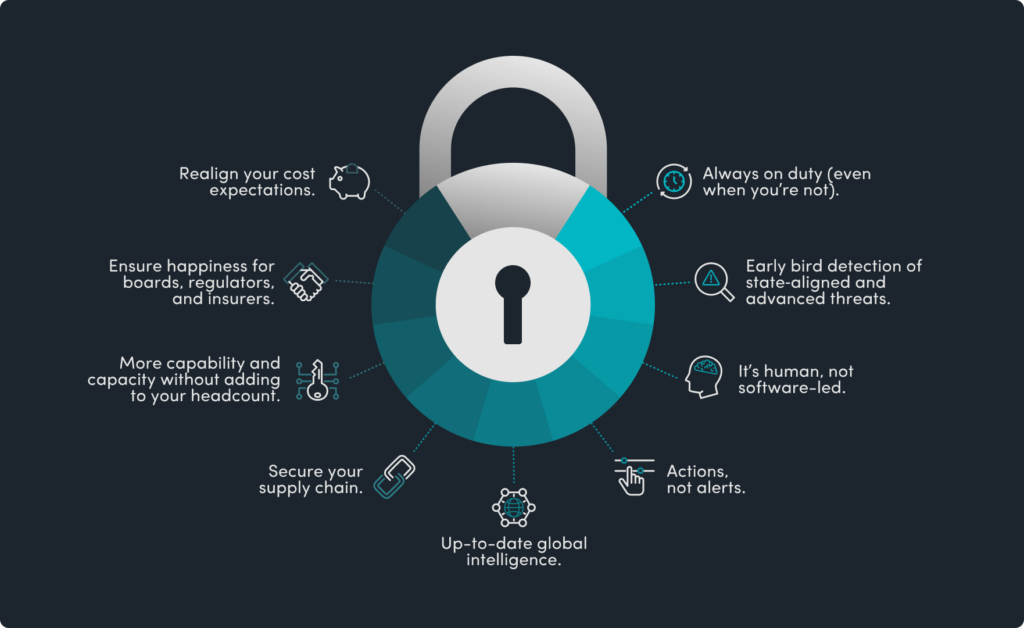
Always on duty (even when you’re not).
When threat levels are elevated, MDR provides you with 24/7 monitoring across your endpoints, networks, cloud, and identities. This means any threats are detected as they emerge, not after damage is done – so it’s never a case of slamming shut the stable door after the horses have bolted.
Early bird detection of state‑aligned and advanced threats.
By their very nature, geopolitical threats are often slow and hard to detect. They tend to include living‑off‑the‑land techniques, credential abuse, stealthy lateral movement, long‑dwell APTs (an advanced persistent threat is where attackers remain quietly hidden inside your environment for an extended period – sometimes for weeks or even months – as with the Styker attack). MDR enables early detection of these threats by identifying low‑noise behaviours, correlating low-grade signals over time, and applying expert judgement to uncover your adversary’s intent before impact occurs.
It’s human, not software led.
Cyber threats aren’t clean, predictable technical problems (sadly). If they were, then all we’d need is up-to-date platforms a sprinkle of AI, and we could all enjoy long lunches and stress-free sleep. Today’s reality is that attacks are multi‑stage, creative, and deliberately designed to evade automated controls. Which is why adding MDR analysts (yes, real people – not AI standalone) to the mix is so invaluable. They have the finely tuned ability and years of experience needed to interpret intent, connect weak signals, and recognise when “normal‑looking” activity is actually malicious. Human‑led MDR allows analysts to recognise emerging attack patterns before signatures exist, adapt detection logic in real time, and learn from one incident and immediately improve protection.
Actions, not alerts.
During global unrest, response time matters. MDR doesn’t just issue notifications – it acts. Rapid, human‑led response and containment play a large role in MDR, including immediate validation of incidents (reducing false positives), containing compromised hosts or accounts, blocking attacker infrastructure, and something we know is especially important to our customers: supporting business‑critical decision‑making when you’re under pressure. So, if your services, leadership, or trusted suppliers are under attack, you don’t need to go it alone in deciding the ‘what next?’
Up-to-date global intelligence.
Nothing remains static when there’s geopolitical unrest – you need to be able to stay on top of and understand the implications of real‑time threat intelligence. This includes recognising indicators tied to active conflicts, sanctions and retaliatory campaigns, hacktivist and proxy group activity, and industry‑specific targeting. Whereas a traditional static SOC (security operations centre) may struggle to keep pace, human-led MDR security teams can dynamically adjust detection logic and priorities as the geopolitical landscape changes.
Secure your supply chain.
Modern conflicts rarely stay contained – they spread like unwanted stains. Attacks often “spill over” into multinationals, managed service providers, shared platforms and SaaS ecosystems. An MDR solution helps identify and react to emerging abnormal behaviour originating from what you thought were trusted connections – suppliers, partners, or MSP tooling – before it spreads through your environment.
More capability and capacity without adding to your headcount.
During periods of crisis, your internal IT and security teams are likely to be under‑resourced, over-stressed, distracted, or simply struggling as they also try to deal with BAU risk. With MDR, you can supplement your team with experienced security personnel. The benefits? Follow‑the‑sun coverage for starters. Then, there are clear escalation paths and incident guidance aligned to real‑world threat conditions. This level of resilience is essential when geopolitical risk becomes a very real business risk.
Ensure happiness for boards, regulators, and insurers.
Geopolitical cyber risk is increasingly a board‑level and regulatory concern, particularly if you are in government, critical infrastructure, finance, healthcare and defence-related industries. MDR demonstrates your commitment to active risk management – ticking the compliance boxes for documented monitoring and response, incident timelines, expert reporting, and alignment with modern cyber‑resilience expectations. All of which can be critical for regulatory confidence, executive assurance, and cyber‑insurance discussions.
Realign your cost expectations.
You’d think (given what it does to manage risk) that MDR is another of those bite-the-bullet moments when you’re looking at your budget.
But no, it’s not. For the cost of an in-house Junior Analyst, you get MDR services that include a full 24/7 team of skilled and experienced senior analysts. We also remove your overlapping tools (the ones that double-up on functionality) which increases your licensing ROI. It’s hard to argue with that kind of value, right?
You could set up your own MDR services, though? Yes – but at a cost. Starting with three analyst salaries – if you can even find, recruit and retain these sought-after specialists.
Not all MDRs are created equal
Tarian Cyber specialises in cybersecurity for Microsoft environments.
Our senior-only, Australian-based team builds and runs a 24/7 MDR capability directly in your environment. This way, you get more value from your investment. And as we operate within your tenancy with your data, you have complete visibility and security operations built just for you.
So, during times of unrest, you can rest assured: Our MDR will protect your business by combining continuous monitoring, expert‑led (human) detection, real‑time intelligence, and decisive response.
We keep you well-equipped to stay safe from the realities of modern cyber conflict.

